
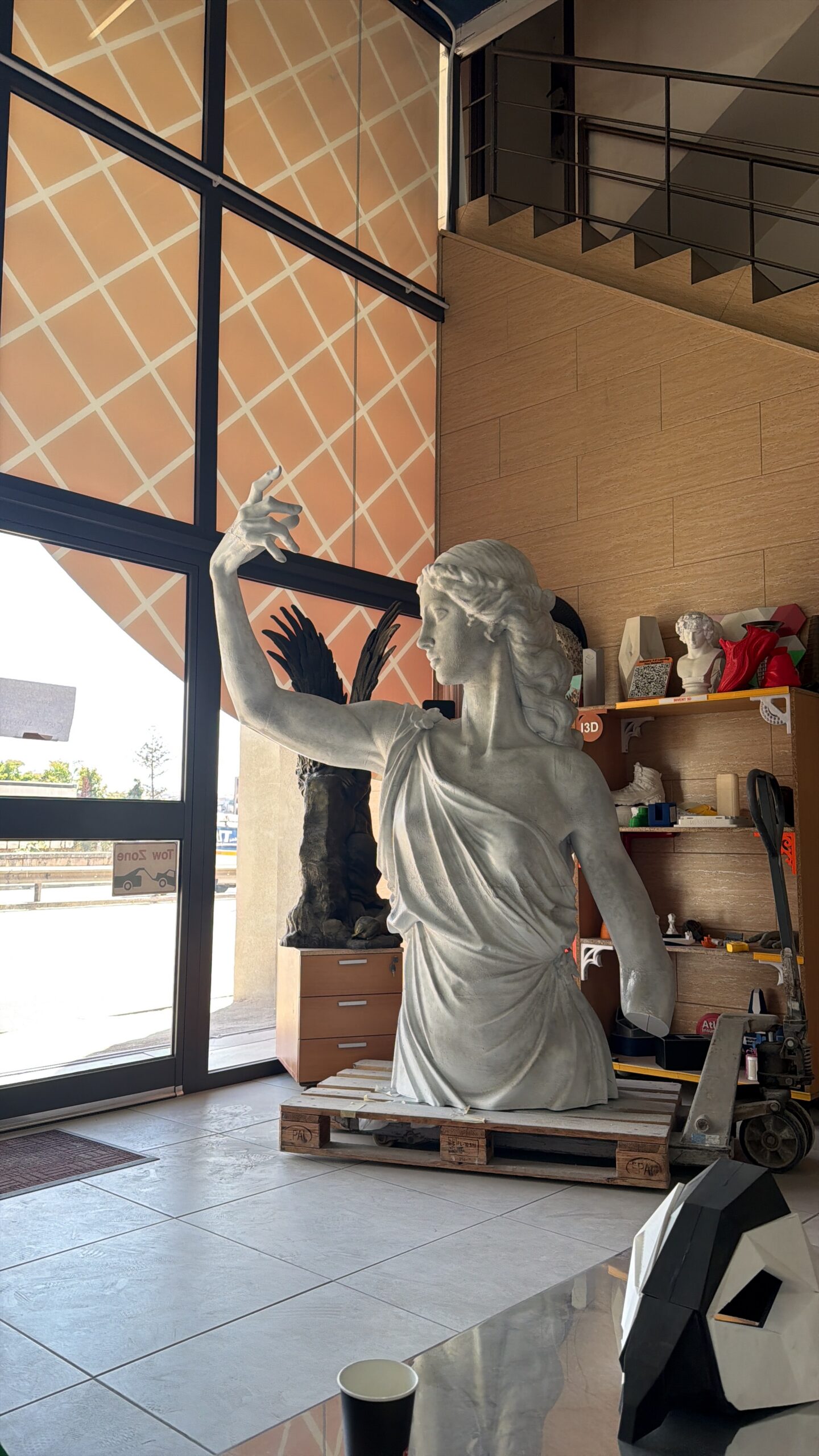
How Large-Scale 3D Printing Is Transforming Event and Commercial Décor
Massive statues have always been designed to make an impact.
Whether they are placed at the entrance of an event, used as a centrepiece for a brand activation, featured in a film production or installed as permanent décor, large sculptures are designed to be noticed.
Creating a massive statue has traditionally meant weeks or months of sculpting, mould-making, casting, fabrication and finishing.
Large-scale 3D printing is changing that.
At Invent 3D, we use additive manufacturing, digital design and advanced finishing techniques to produce large 3D printed statues and sculptures at a scale that would be difficult, expensive or impractical using traditional manufacturing methods.

What Is Large-Scale 3D Printing?
Large-scale 3D printing is the process of manufacturing oversized objects by building them layer by layer from a digital 3D model.
Instead of creating a single enormous piece, a massive statue can be digitally divided into multiple sections. Each section is then 3D printed, assembled and finished to create one seamless sculpture.
This approach allows us to produce statues that can be several metres tall while keeping individual printed components manageable for manufacturing, transportation and installation.
The result is a combination of digital sculpture, engineering, 3D printing and traditional finishing.

How Do You 3D Print a Massive Statue?
Creating a giant 3D printed statue involves much more than pressing “print”.
The process typically begins with a digital 3D model.
Depending on the project, this could be:
- An existing 3D model
- A character or mascot
- A product or object
- A digitally sculpted figure
- A scan of an existing object or person
- A completely new design created specifically for the project
Once the model is ready, our team analyses its geometry and determines how it should be manufactured.

1. Digital Design and Preparation
Large statues need to be engineered for real-world manufacturing.
The model may need to be scaled, hollowed, reinforced and divided into multiple sections.
We also consider:
- Overall dimensions
- Weight
- Structural requirements
- Assembly points
- Transportation
- Installation
- Internal reinforcement
- Surface finishing
- Final location
This is one of the major advantages of working with a company that combines 3D printing and product development rather than simply outsourcing the printing process.

2. Splitting the Statue Into Sections
A three-metre statue cannot necessarily be printed as one enormous object.
Instead, the digital model is divided into sections that can be manufactured individually.
These sections are designed with assembly in mind, allowing them to be joined together after printing.
Depending on the project, we can incorporate:
- Internal supports
- Mechanical connections
- Alignment features
- Reinforcement points
- Access panels
- Mounting systems
The final goal is for the individual pieces to become one coherent sculpture.

3. Large-Scale 3D Printing
Once the model has been prepared, the individual sections are manufactured.
Large-format additive manufacturing allows us to produce components much larger than those possible on conventional desktop 3D printers.
For particularly large projects, we can manufacture the statue in dozens of individual components.
This modular approach provides an important advantage: the size of the finished statue is not necessarily limited by the size of the printer.
Instead, the manufacturing strategy determines how the final sculpture is constructed.

What Materials Are Used for Giant 3D Printed Statues?
Material selection depends on the application, size and environment of the statue.
Large sculptures are commonly manufactured using thermoplastic materials because they offer a useful combination of strength, relatively low weight and manufacturability.
One important consideration is that large statues do not need to be completely solid.
A massive sculpture can often be produced as a hollow or lightweight structure, significantly reducing the amount of material required.
This makes the finished piece easier to transport, assemble and install.
Internal reinforcement can also be incorporated where additional structural strength is required.

From 3D Print to Finished Sculpture
The 3D printed component is only the beginning.
If you want a professional-looking statue, the printed surface usually needs significant post-processing.
Large-format 3D printing creates visible layer lines. Depending on the desired finish, the surface can therefore go through several stages of finishing.
These may include:
Assembly → Filling → Sanding → Priming → Painting → Detailing → Protective coating
The amount of finishing required depends on the final application.
A temporary event installation might require a different finish from a museum display, permanent public sculpture or premium brand activation.
This is where 3D printing meets traditional fabrication and finishing techniques.

Why Use 3D Printing for Massive Statues?
There are several reasons why 3D printing is becoming an attractive manufacturing method for large sculptures.
Complex Shapes Are Easier to Manufacture
Traditional fabrication can become increasingly complicated as a sculpture becomes more detailed.
3D printing works directly from digital geometry, making it possible to manufacture highly complex shapes, organic curves and intricate details without requiring traditional moulds.
No Traditional Mould Is Required
Traditional casting often requires the creation of moulds before the final sculpture can be produced.
For one-off statues, this can add significant cost and time.
With 3D printing, the digital model can be manufactured directly.
This makes additive manufacturing particularly useful for custom statues and one-off sculptures.
Digital Designs Can Be Scaled
A digital model can be resized before manufacturing.
A character designed at 500 mm can potentially become a 2-metre, 3-metre or even larger sculpture.
The model can also be modified before production, allowing the design to evolve without rebuilding an entire physical mould.
Lightweight Structures
A giant statue doesn’t necessarily need to be a giant block of material.
3D printing allows us to control the internal structure of components, reducing unnecessary material while maintaining the required geometry and strength.
This can make large sculptures considerably easier to handle.
Repeatable Production
Once the digital design has been finalised, additional statues can be manufactured using the same digital production files.
This is particularly useful for brand activations, event campaigns and installations requiring multiple sculptures.
Where Are Massive 3D Printed Statues Used?
Large 3D printed sculptures can be used across a wide range of industries.
Events and Exhibitions
A giant sculpture can become the focal point of an exhibition or event.
Brands can create oversized logos, mascots, products or themed installations that immediately attract attention.
Brand Activations
Marketing campaigns increasingly rely on physical experiences that encourage people to stop, photograph and share.
A massive custom sculpture can become part of that experience.
For example, a brand might create a giant version of its product or a highly recognisable character for an activation.
Film and Television
Large-scale 3D printing can also be used to create props, creatures, architectural elements and other physical assets for productions.
Digital files can be transformed into physical objects without the need to manually fabricate every complex component.
Retail and Commercial Spaces
Large sculptures can be used in shopping centres, hotels, restaurants, corporate headquarters and entertainment venues.
They can serve as permanent décor or temporary installations.
Public Art and Installations
Large-format additive manufacturing also opens new possibilities for public art.
Artists and designers can develop geometrically complex sculptures that would be difficult to manufacture using conventional techniques.
How Big Can a 3D Printed Statue Be?
There isn’t necessarily a single maximum size for a 3D printed statue.
The practical limit depends on the manufacturing equipment, design, transportation requirements, installation location and how the sculpture is engineered.
Instead of asking:
“Can we print a 4-metre statue?”
the better question is:
“How should we manufacture a 4-metre statue?”
A large sculpture can be designed as a series of interconnected sections and assembled after manufacturing.
This means a finished statue can be significantly larger than the build volume of an individual 3D printer.
Designing for Installation
One of the most important aspects of large-scale statue production is thinking about the final installation from the beginning.
A sculpture might need to pass through doors, elevators or loading bays before reaching its final location.
It may also need to be transported between countries or assembled on site.
For outdoor installations, additional considerations can include:
- Wind loading
- Weather exposure
- UV exposure
- Anchoring
- Internal reinforcement
- Protective coatings
- Drainage
- Maintenance
These factors need to be considered during the design and engineering stage rather than after the statue has already been printed.
Creating Your Own Massive 3D Printed Statue
Whether you need a giant mascot for an event, a statement piece for a commercial space, a large-scale prop for a film production or a completely custom sculpture, the first step is turning the idea into a manufacturable design.
At Invent 3D, we combine product development, digital design, additive manufacturing and post-processing to create large-scale physical objects.
We don’t simply print a model and hand it over.
We look at the entire process — from the initial concept and digital model through manufacturing, assembly, finishing and installation requirements.
PS: The Invent 3D founders also launched ELM Fabrication, together with Ing. Nicholas Borg Calleja – where we developed a large-scale 2m x 2m x 6m machine.
The largest 3D Printer in the Mediterranean…. and it is Made & Designed in Malta.